Bad Ted Friend Chris (co-host of the 120 Outdoors podcast) took me on my first steelhead fishing trip last Thursday. Never went steelhead fishing in a Lake Erie trib before. Did not catch a fish. Had an absolute blast. Really.
Bad Ted Corollaries:
In the last post, I said that “if you fish, you do not have to be fishing to have fun fishing”. Now a corollary: “If you are fishing, you do not have to catch fish to have fun fishing.” It is more fun if you catch something, I am not denying that. But I also said in a previous post that it is not all about catching the biggest or the most, it is about having fun fishing with family and friends.
I want to be clear: I love catching fish! It just is not a requirement to catch fish on every trip. (If you fish for muskies, you already know that, feel that actually.)
What We Wanted to Do:
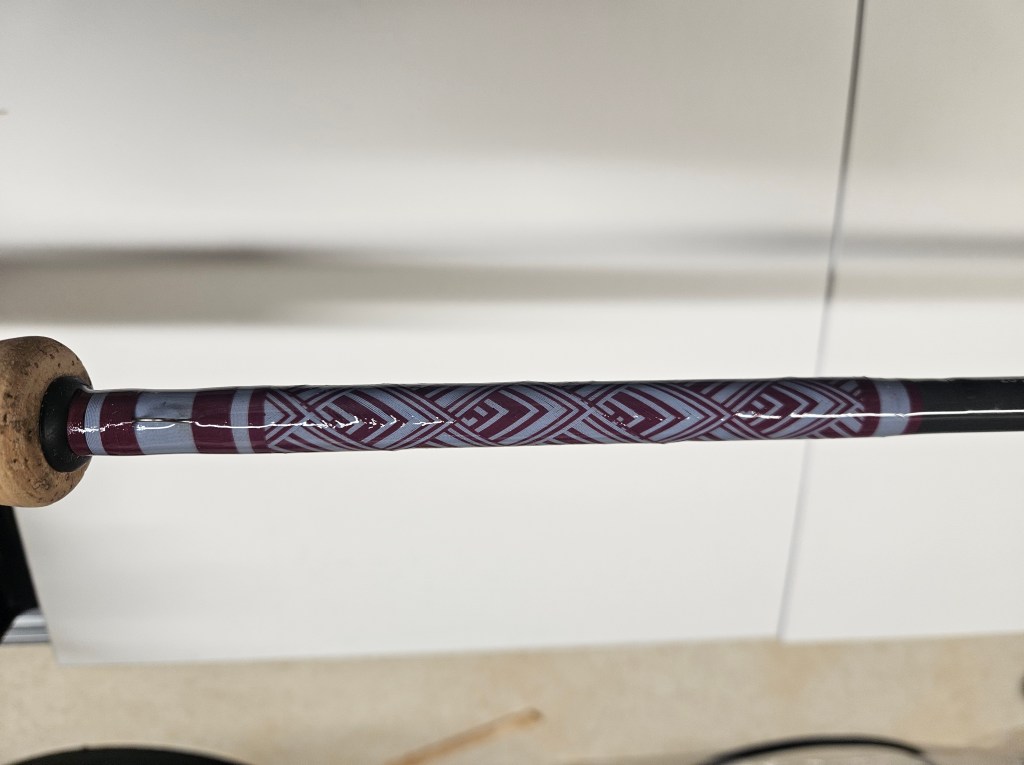
So how can it be fun if you do not catch fish? Well, Chris and I stood in the middle of the stream and talked about how we wished we were catching fish. No, not really. Well, maybe a little. Chris has been fishing the Lake Erie tributaries for steelhead for decades, and the goal of the trip was twofold: First, I wanted to find out what this sport entailed, and second, I wanted to field test the drift rod that I built a month or so back. Chris’ goal was to get me started so we can fish for steelhead together. From my perspective, this was as much a learning and teaching trip as it was a fishing trip.
If you are thinking about trying this game, this post may help. If you are an experienced steelhead angler, this might make you scratch your head, maybe even have a good belly laugh.
Required Equipment (or so I thought):
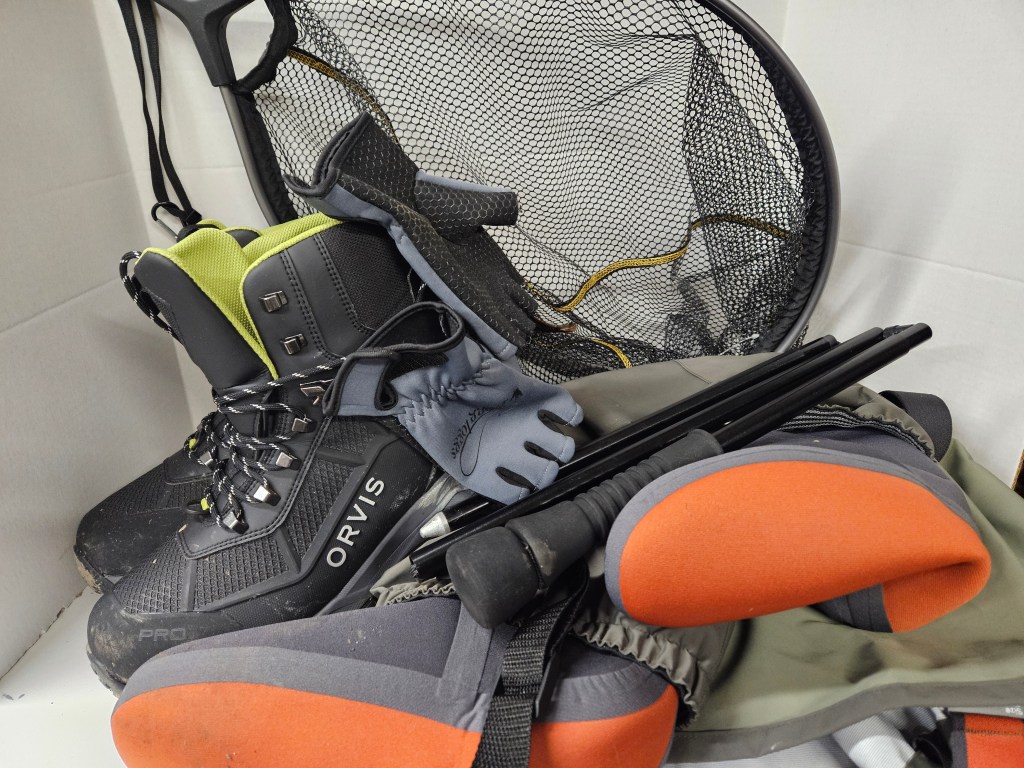
First, let’s look at the equipment that I gathered. All this equipment is new, so, in the interest of full disclosure, I have to tell you that I truly felt like the rookie who just showed up looking like a sporting goods store showroom, all shiny and new. Wait, I actually was that. Anyway, with the help of the good folks at the Neshannock Creek fly shop, I picked out a good pair of stocking foot waders and wading boots. They put studs in them for me, suggesting that it would be foolish to not have them. They also sold me a net, but I did not take it with me on this trip. Chris showed me how he uses a landing hand, but I have yet to buy one. I also purchased an Orvis 7 wt fly rod, but left that with the net, opting to try float fishing with a spinning rod. (Probably because that I am not great with a fly rod.) I built a 10 1/2 foot two-piece steelhead spinning rod, added an Okuma Ceymar reel, a baitfeeder reel, spooled it with 10 # braid and used 8 # flourocarbon for a leader. Some #12 hooks and salted minnows completed the outfit. I put my lures and hooks into a small backpack, not wanting to spend the money on a wading jacket before I knew what I needed. But I did not take a carpet to stand on while putting on my waders, or a chair to help, but Chris brought them for me. That was my first lesson.
School Is in Session:
The first thing Chris did after we said hello was take a look at the stream. Apparently, even though the flow charts are accurate, conditions still may not be great, or they may have changed since you last checked. He said that this stream had good flow and good color. He had decided to wait a couple of days from our original date to go because the rain in the area had made the streams unfishable, but he had it just right and these were great stream conditions. Chris cautioned that the rain and the time of year may have resulted in the fish heading back to the lake. If that was the case, all we would find would be recently stocked smolts.
It was the case.
I was not deflated, however. These were great conditions for learning and school had already started. Earlier in my life I fished salted minnows during Pennsylvania’s trout season, and I was familiar with the concept of floating bait for fish. This is same but different. Chris showed me how to use a Raven float, an extremely easy tool to use to set the depth of the minnow, and then how to build a daisy chain of split shot. He explained how this set up helped the minnow get down quickly, and how when properly weighted, the float is completely upright in the current, offering a drag free float. We played with the weight in different currents as we waded upstream. I appreciate that Chris works his way upstream rather than down because that keeps you from sending a cloud of silt and mud through a spot before you fish it. We worked on my technique quite a bit. Managing slack line, mending it if needed, but letting it float naturally, casting to the right spot, reading the water, and sensing a strike (even if they were smolt, it was good practice) are all skills that I need to develop. It turns out that wading without falling is also a skill. NO, I did not fall in, but I am pretty sure that Chris has never seen anyone wade that slowly.
Equipment Issues:
I did have one good fish hit and flash, but the line broke. I am not sure why, but I did not do a good job of setting the hook or handling the brief fight. I think part of the problem was the new reel, or rather me using a new reel. I never used a baitfeeder reel before and upon reflection, I think I may have tried to set the hook before I turned the handle, thereby giving the fish some slack. I am not sure, but I need more experience before I can decide if the free drift from the reel is worth learning a new hook setting technique (if I even can).
And then there was the backpack issue. I like taking a pack because I can take layers off and stick them in the pack as the day warms and I can carry all my lures, snacks, and water. That day it was below freezing when we started and headed to the mid-forties. As it turns out, when the water temperature is just above freezing, it creates freezing thighs, which negates any temperature gains. (Who knew?) I usually take my pack off and leave it along the stream while I wade and a pack is easy off, easy on. And easy to leave on the bank when you move, forcing a 1-mile round trip hike to retrieve it. Then there is finding anything in it. Not enough compartments. So, since I forget it, I cannot find anything in it, it doesn’t get warmer anyway, and Chris showed me that his wading jacket has a dry back pouch, I am not taking a backpack again. I have a small sling pack that will do just fine, and I don’t have to take it off. Or, maybe I should just get a wading jacket. Novel idea.
I Need this Equipment:
The lack of a wading jacket became a problem. Without an over jacket, I could not easily get my hands into the wader pockets to take advantage of the hand warmers. Chris’ jacket has easily accessible pockets that are lined for warmth. It is windproof and has that carrying pouch. I need one. Okay, I want one.
I also need to wear sweatpants with a light base layer, at a minimum. Long johns actually sound like a good option. Convertible fishing pants are great in July, but not in March. I wore wool socks and my feet were good, so, note to self. A net or a landing hand are required. Period. Wading on a slippery surface to beach land a fish is out of the question. (Maybe everybody knew that, except me?). Finally, I need to get a pair of fingerless felt gloves. My Frogg Toggs shed water pretty well, but the extra layer of warmth could be helpful on a colder day.
When and Where to Fish:
Experienced steelheaders keep track of the flow reports religiously. If flow rates are too high, the water is unfishable and dangerous. But not all streams are necessarily “blown out” at the same time. They can be, but not always. The day we went, an Ohio stream was too high. A flow rate of 150 or below is safe, but it was at 500 when Chris checked, and when I stopped at a local sporting goods store, they had posted the flow at 752 at 8:30 that morning. But the streams in Pennsylvania were actually in good condition, as noted.
Time of year and stream location are also key considerations. The steelhead fishery in Pennsylvania and Ohio depends on well-conceived stocking programs, but there is a difference. Chris explained that Ohio stocks a strain of fish that runs up the tribs in the spring, so fish may be in the Ohio streams throughout the course of the spring. On the other hand, Pennsylvania stocks a fall run strain, and by this time of year, late March, most of the fish that wintered in the streams have returned to the lake. As of today, the only steelhead in the streams will probably be in Ohio.
Even fishing pressure can come into play when deciding if and where to fish. Pick a weekday and avoid Friday, Saturday, and Sunday.
My lack of experience is also a factor for me. Experience allows you to refine all of your angling skills and techniques, and your knowledge of the streams helps keep you safe. You have to be willing to drive to a location and accept that the conditions are not safe, or fishable, and be okay with that. Sometimes, the next stream will be fishable. Sometimes, you need to just go home so that you have a next time another day. At my age, I have really become a fan of “another day”.
A Lifestyle:
One of the things that I found interesting about this style of steelhead fishing is that it has its own subculture in NW Pennsylvania and NE Ohio. Let me share one short story that illustrates it as well as anything. While we were sitting by our trucks eating lunch, a UPS truck came rolling down the road and unexpectantly stopped right beside us. The door opened and the driver, a young man, leaned out, so I thought Chris was getting a delivery. But the driver wanted to know how we did, commented on the ill effects of the recent rain, the unfavorable winter for steelhead fishing, and how his chances to get out were waning. Only after we talked steelhead fishing did he decide to make his delivery.
Final Thoughts:
On this day, I had a ball. I spent a crisp, sunny, March day along a Pennsylvania stream with one of my closest friends. We fished. We talked. We laughed. He taught. I learned. We called the day a little early and since I had never been there, we ran down to Trout run and saw two pods of fish that had a couple of monsters in them. We ate lunch and talked while we sat in between our trucks on the chairs he brought. I had a 90-minute trip home and had been up since 5, so I enjoyed getting home for supper.
I am going again. I think that I am hooked on steelhead. I know that I had fun fishing with a friend.
_______________________________________________NEXT: I review the equipment I used on the trip, focusing on the custom rod build, the Bad Ted Steelhead Series prototype.
 badtedfishing.com
Leave a comment