
Recap: Muskie fishing is demanding. It wears you out. It beats you up. And we love it. But, as an aging angler, the fatigue from casting for muskies reduces my time on the water. I just cannot fish for 8 or 10 hours a day. Two or three hours of casting use to wear me out. I think that is the number one reason why I am struggling to catch fish. You cannot catch them from the recliner.
I want to catch a few more fish. I do not need to catch the most fish, but catching one once in a while helps my attitude and enjoyment. So, I came up with 7 strategies to combat the effects of musky fatigue, that weariness and pain that sends me home early. Parts I and II of this blog covered the first four: Downsizing, Trolling, Taking Breaks, and Changing Baits. This is part III, the final part. In it I will cover the last 3 strategies: #5 Improve your techniques for casting, retrieving, and presentation, #6 Be efficient in your boat set up, and #7 Take care of your body. Let us start with a discussion about technique.
# 5 Improve Your Technique for casting, retrieving, and presentation:
*Casting: Let the rod do the work. If you are not trolling, the thing we do the most is cast. It is not uncommon for an angler to make over 500 casts in a day. The easiest way to wear yourself out is to work too hard on the cast. Let’s look at what the rod is doing during the cast, and then, how we can take advantage of that and improve our technique.
During the back cast, the rod flexes backwards, known as loading. As the rod comes forward, the rod releases, sending the tip forward rapidly and launching the lure. The best way for me to cast is to hold the rod perpendicularly and use an overhead motion. My reeling hand holds the very end of the rod, and I pull it straight down and back toward my stomach at the same time that my other hand pushes the rod tip forward, basically from 2 o’clock to 10 o’clock. I do this quickly and sharply, but I do not try to overpower it. The tip and the butt of the rod stay in the same plane in order to maximize the rod speed and efficiency.
When I cast overhand, the rod does the work. It will travel through its longest arc, generating the maximum speed and power. Trying to muscle the rod and throwing the lure as hard as I can only tires me more quickly and rattles my elbow and shoulder. I am not throwing a lure; I am casting it with a rod. I have to remind myself about this from time to time. I think I can get a longer cast by really putting everything into it. Wrong. Even if I would get a couple of more feet of distance, it just is not worth the extra effort. Let the rod do the work, use less effort and fish longer.
There are times when I want a low cast. Then I just rotate everything to the horizontal position and use the same casting motion.
*Casting: Mach your Equipment: One more thing about casting. Use the right equipment. I build my own rods and in recent years I have taken to using oversized grips, at least on the butt end. As we age, our joints become less flexible. Our hands lose grip strength. It becomes easier to grip a thicker handle than a thinner one. Try it. Grip a wooden pencil and try to pull it out of your hand. Then try it with a broom stick. See the difference?
I also try to match my equipment. I talked about using smaller reels in the downsizing section. I did not talk about the impact of using matched equipment. Matching lures to rods allows the rods to perform at their maximum efficiency. When they work well, we work less. If you use a lighter rod but use heavy lures, the rod tip collapses on the cast and cannot generate sufficient speed to deliver the lure. When that happens, we try to compensate and muscle the cast in order to generate more speed. That only wears us out. Conversely, a light lure on a heavy rod cannot load the rod enough to allow the tip to generate any speed. Again, we try to muscle the rod to get more speed, and again, unsuccessfully.
It is also helpful to be smart on how we retrieve our lures. I used to rip a Suick with a great rotation of my torso and full extension of my arms. Did it for hours, but now, about two of those would sit me down. But then I found that shorter pills and snaps, matched with the right rod, can produce amazing action and results. One of the most exciting strikes I ever saw was when a 44-inch muskie T-boned a Suick just as I started my figure 8. I had been using short pulls and a pause every 2 or 3 pulls. I watched this fish approach from a 45-degree angle, turn and attack the lure, coming out of the water as she did.
I also use the reel to help add action to a bait. Reel, reel, pause. Reel, pause. Reel, reel, reel. Change the cadence and the speed and change the action. Basically, let the rod, reel, and lure do as much work as possible.
#6 Boat Set Up: Make it efficient
Setting up a boat so that you expend the least amount of energy and stay safe is just a matter of thinking it through. This might be a bit self-explanatory, and you probably have worked on how you like your boat set up for quite a while. So I am just going to throw out a couple of ideas that I use.
I use a leaning post. Most muskie guys do not, and I get that. It is very hard to figure 8 from a leaning post. But I give up that little bit of efficiency in presentation in order to stand longer and therefore, fish longer. I still figure 8, and if I see a fish following, I am fully on my feet and at the rail in order to present a good target for the fish. With the leaning post, I also feel a little safer, especially when I am hit with an unexpected wave.
In order to be safe and use less energy, I added a modification to my boat. I normally fish from the front deck. The step up to that deck is 14 inches. Now when my eyes see that step, my brain says “Never been a problem. Step up.” My legs say, “We are aging, and we can only step up 12 inches.” Unfortunately, sometimes my brain does not get that message in time, and I might have ended up face down on the deck. Maybe.
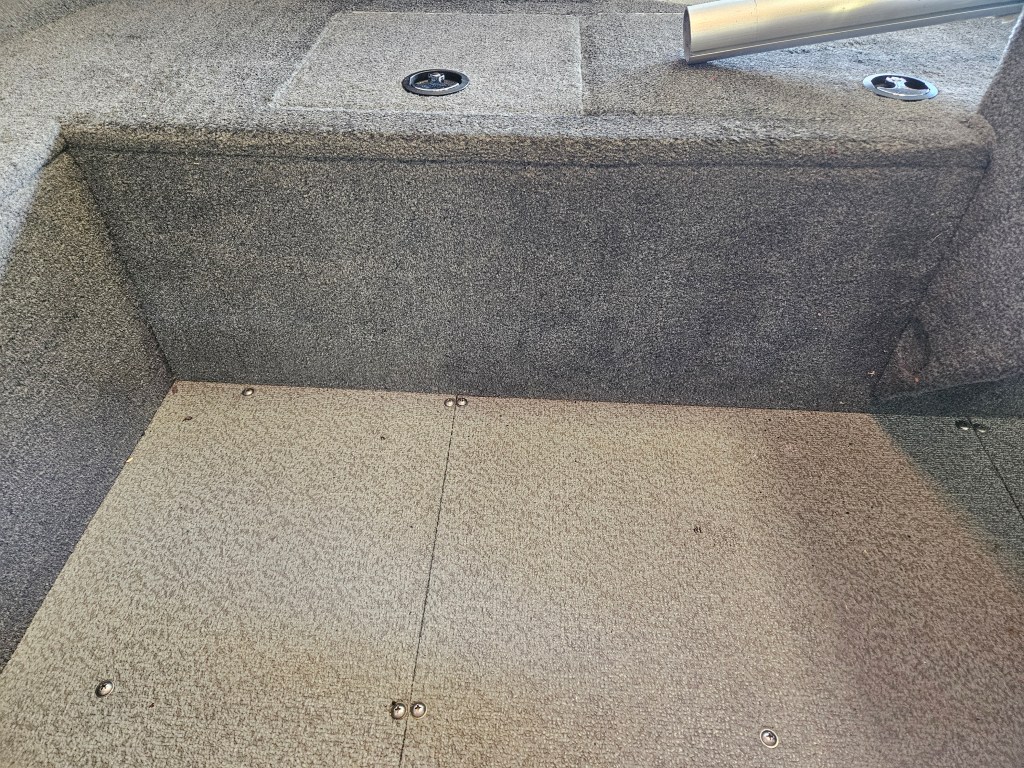
To fix that, I built a 7-inch box that I slide against the deck to make a 7- inch step. It also serves as additional storage.

#7: Take Care of Your Body
Taking care of your body can give you extra strength and stamina, which allows us to fish longer and spend more time on the water. This means taking care of yourself before you go fishing, and then while you are fishing.
When I was younger, I was pretty fit, and I did not have to worry much about being fit enough to fish all day. And I often did. At 74, I have to work at being strong enough, having good balance, being as flexible as possible, and having some stamina. Now, I hate working out, but it has become as necessary as taking along a fishing rod. I cannot fish without a rod or without exercising. (See the previous blog, “I Hate Working Out” for information on how I exercise for specific outdoor activities.)
So I exercise 3 or 4 days a week. I do body weight exercises and use tension bands to help with strength, especially for legs and core. I do workouts with a Bosu ball and pods for cardio, core, and balance. I stretch for 15 minutes every day. And I woods walk 3 days a week. I have seen a significant increase in my ability to stand and maintain my balance in the boat, and I very definitely have been able to cast and stay on the water longer. Even with using all of the 6 other strategies, I do not think I would see the gains that I have if I was not exercising. You can find an exercise program that works for you, even if it is just walking each day. It will help.
The other component of taking care of your body involves the time that you are actually on the water. We know what to do, but we do not always do it. First and foremost, do not forget to stay hydrated. Also, protect yourself from the sun. Sun and a lack of water can lead to sunstroke. It happened to my wife, and it was very scary. Please do not let it happen to you.
Sunburn can get you off of the water and be a real pain for days to come. Some of us who fish in the northern United States do not seem to have learned anything from our southern fellow anglers. But we should. Wear sun protection clothing, use a hoodie, and cover your hands when the sun is beating down on you. I have not been able to use a face mask yet, but if you can, there are some really cool ones. Protective clothing will help you stay on the water, avoid injury, and help prevent skin cancer.
Summary:
I can stay on the water longer and fish more safely and efficiently if I use the last 3 strategies of our 7 strategies to defeat musky fatigue, along with the first four strategies. To review, these strategies are: (#5) It helps to be efficient in how I cast, and retrieve. I match My equipment and use a good technique to cast. When I do, I do not tire as easily because I am minimizing the work I need to do to cast effectively. By working smarter, not harder, I get to fish longer. (#6) Set up the boat to help conserve energy. (#7) Take care of your body by being fit as you can be. And finally, protect yourself from the dehydration and the sun.
These 7 strategies have helped me be able to fish longer each day, as well as more days. I may or may not be doing all of these all of the time, but they have helped. To recap the strategies: #1 Downsize, #2 Troll, #3 Take breaks, #4 Use different baits, #5 Improve your techniques for casting and retrieving, #6 Set your boat up for efficiency, and #7 Take care of your body before and during your time on the water.
I have put these strategies out there for the aging angler. Things that are never even in our mind when we are young can actually keep us from fishing as we age. But even for younger anglers, these strategies will make it easier to fish. Then when you are my age, they will just be what you do.
I do not want to quit fishing, and probably never will, with a little luck and planning. I am going to fish the way I always have for as long as I can, then I am going to change how I fish so I can still fish. I might have to do that a couple of times, but that is fine. But I am not ready to change how I fish just yet. These are strategies to keep me fishing the way I want to fish. But no matter what, I will always find a way to go fishing.
I hope this helped you in some way. I hope you come back, but whether you do or do not, please be safe and always wear your PFD. Most of all, Have fun. Go fishing.
 badtedfishing.com
Leave a comment