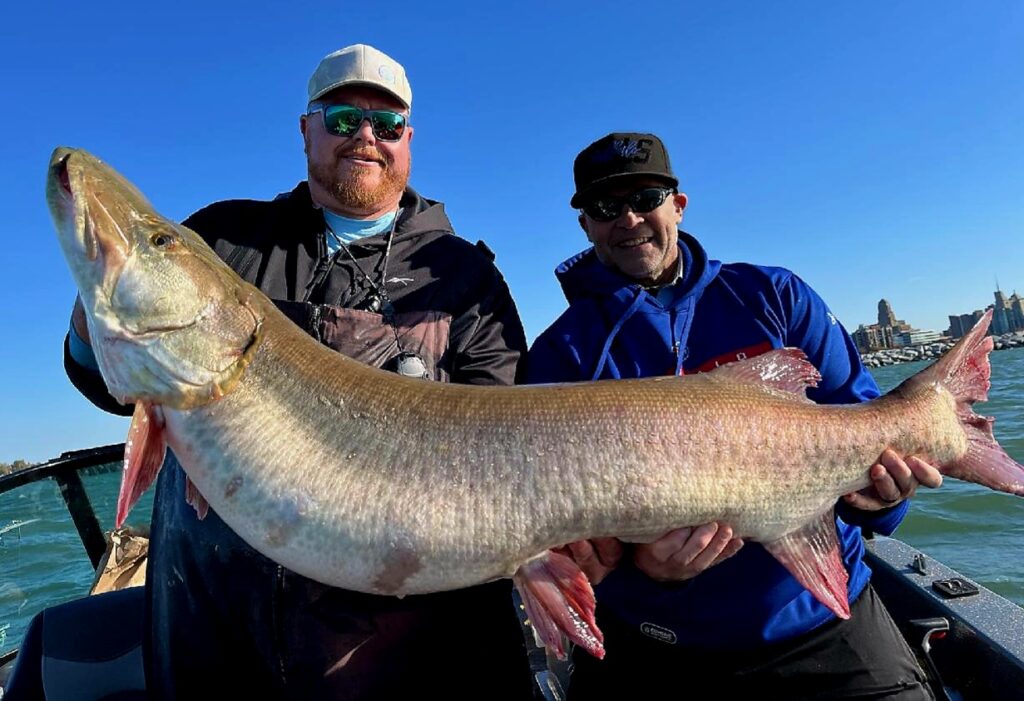
If you do not give careful thought and attention to your terminal tackle when you are trolling for muskies, you are going to lose some fish. And that’s a fact.
Early in my musky fishing journey, when I trolled for muskies I got the trolling rod out, popped on a crank bait, let out 40 feet of line and trolled off the weed beds, around points, and over channels. And that was all there was to it. Easy, right? Wrong. Very wrong. This next statement will not surprise experienced trollers, but I did not catch many fish. It turns out that trolling for muskies is a complicated matter, when done right. One thing that must be done absolutely correctly, is the use of terminal tackle. But I had a lot to learn about trolling for muskies.
So off I went on my quest to learn how to troll for muskies. I read a lot and listened to multiple podcasts that discussed trolling for muskies. I heard a lot about strategies and techniques for different types of water and different seasons, what lures to use and when, if or when to use monofilament or braid, how far behind the boat to run the lures, how to use boards, how fast to run the boat and how long of a leader to use. All great stuff. But very little was ever said about the specifics of terminal tackle, which is basically everything beyond the main line. Fail there and you, well, you fail. And there are a lot of things to consider. So, I turned to my friends.
I have the good fortune to know three of the best musky trollers around: Captain Hans Mann (more commonly known as Hans the Carver), Kevin Goldberg, and Chris DePaula of the 120 Outdoors Podcast. I asked them if they would share what they have learned over decades of experience, and they all readily agreed. Let’s see what they had to say.
Captain Hans Mann, a.k.a. Hans the Carver
A Little about Hans:
Hans is a big muskie specialist and is one of the creators of Red October tubes. In the last two years he has introduced his line of Carver musky lures, indestructible and irresistible to muskies. He also may be the best multi-species fishing guide on Lake Erie, working out of Buffalo harbor, New York. Hans is one of the few people who consistently catch giant muskies on the eastern end of Lake Erie and the Niagara River.
The Starting Set Up:
Hans uses two basic set ups for trolling, one for his down rods, and one for flat lining, with or without boards. Both set ups start the same, however. The difference is in the leaders he uses. Although it is not terminal tackle, consideration must begin with the main line. Both set ups start with 80 # braid. Use whatever braid you want, as long as it is reliable. The braid is connected to a stainless steel 240# Mighty Mini swivel, produced by AFW (American Fishing Wire). These are smaller in size, but extremely strong and reliable. They are connected with the only knot Hans uses to tie braid, the palomar knot. (For a video on this knot click here : Bing Videos )
Steel Leader Set Up:
Hans uses down rods for his deeper diving lures. These lures run close to the bottom and often are running through rocks, zebra mussels, and other obstructions. For this set up, Hans uses an AFW 174 lb. brown single strand steel leader. He makes them 36 inches long. You can buy these, but I suggest making your own. The reasons for building your own are (1) they are not difficult to do, (2) you are certain of the quality, and (3) if something goes wrong while you are fishing, you probably can fix it. To see how to do this, check out Hans’ You Tube video on this link: High Season_2023_30s . Two notes about this video: 1. Hans begins by stating that he only uses steel leaders. That is for casting purposes. He does also use fluorocarbon when trolling, which we will get to shortly. 2. The leader he is making is for casting, but it is the same process for making a trolling leader. The trolling leaders are just longer, at 36 inches.
The steel leader has the Mighty Mini swivel on one end. The other end has a #4 Mustad Stay-Lok snap, seen here. Both must be attached while you are making your leader.
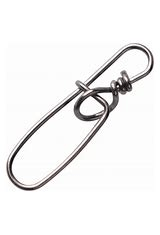
Steel leaders are a better choice than fluorocarbon when trolling near the bottom. Fluorocarbon is a great choice for situations where the lure is higher up in the water column.
Fluorocarbon Set Up:
100# Fluorocarbon is Capt. Han’s choice for leader material when he is running lures up in the water column. These leaders are 6 to 7 feet long. They use the same hardware as the steel leader set up. Hans prefers the fluorocarbon leaders over the steel in this situation because it is easier to manage. A steel leader that long will kink easily, especially if it is wound into the guides.
The fluorocarbon is attached to the swivel and snap using the large fluorocarbon knot. Tying a knot in heavy duty fluorocarbon is a challenge. Hans uses this because it is the easiest knot to use with heavy fluorocarbon. The following link demonstrates how to tie this knot: Bing Videos . With the leader securely in place, there is one more piece of terminal tackle that the captain uses: a clip-on weight.
A 4-ounce clip on weight is the choice for Hans. It is clipped on the end of the main line on the side of the swivel closest to the rod. It is essential that it is added there. Putting it on the other side of the swivel does not work. The 4 ounce weight does not alter the dive curve of the bait and only lowers it about six inches according to Capt. Hans. The weight also stabilizes the bait, letting it run true and also serves as a weed guard. The clip on weight is just one of the things that these anglers do that I am going to try this year.
Having seen what Capt. Hans does, let’s look at Chris Depaola’s approach.
Chris DePaola:
A Little about Chris:
Chris has been fishing for muskies for 44 years. He runs the children’s program for the Cleveland chapter of Muskies, Inc. He was the eastern editor and contributing writer for Essox magazine. A member of the Ohio Outdoor Writer’s association, Chris and his partner Don Clowes were awarded that group’s 2025 Special Media Achievement Award for their 120 Outdoors podcast. He also appeared on episodes of The Next Bite television show with host Pete Maina.
Just Steel for Chris:
Chris has six trolling rods set up and in his boat. He rigs 2 rods with 50# Power Pro braid, 2 with 65# and 2 with 80#. His set ups are basically the same beyond that with just a couple of small differences. He only uses Power Pro for his main line and only uses single strand AFW steel leaders, no fluorocarbon.
In the colder water of spring, Chris downsizes his lures and uses his 50# braid set up. He connects his braid to a smaller, #4, ball bearing with a Berkley Braid knot. (see here: https://youtu.be/Gbbiz0Nk9lI). The #4 is rated at 200#, so it is more than adequate. His leaders are two feet long and are rated at 69#, considerably lighter than what he uses on his other rods. Chris emphasizes that he uses Stay-Lok snaps and matches them to the size of the lure. Using a snap that is too large can hamper the lure’s action. He carries 4’s, 5’s, and 6’s in his boat.
Favorite Set Up:
Most often, Chris is using his 65# combination. Here he goes to a four foot long 124# brown single strand leader. Again, he matches his snap size to his lure. He has had great success with steel leaders, so he keeps it simple and sticks to steel.
80 # Braid Option:
There are two situations where Chris uses 80# braid. Sometimes he wants to keep his lures higher in the water. The extra thickness of the heavier braid helps this. The other situation is where his complete rod set up is heavier because of the potential for massive fish. Trolling the St. Lawrence or Lake Nipissing are examples of where this is a well-advised strategy.
Both Hans and Chris use similar hardware and approach trolling in a similar way. Kevin Goldberg also uses the same types of connections as our other two experts, but adds a different approach at times.
Kevin Goldberg:
A little about Kevin:
Kevin may be one of the most traveled musky anglers in the country. He travels at least 7 weeks each year to destinations in Canada and the United States, fishing exclusively for muskies. While a skilled musky caster, Kevin is well known for his expertise as a troller. You may find him on his home lake in Ohio, or Georgian Bay, Lake of the Woods, the mighty St. Lawrence, The Allegheny River, or any pond that holds muskies. Probably because he has experienced a wide variety of trolling situations, he is a little more nuanced in his choices. He frequently is a guest on the Backlash podcast, talking trolling. (See the contact section at the end of the post.) He also has appeared with his wife on the Simply Fishing television show with Hall of Fame fisherman Bob Mehsikomer.
Common to All Three Trollers:
A few things are common to all three anglers. The snap sizes, type of snaps, leader and line strength, length of leaders, and main line choices are a few of these. Rather than repeat them in detail, I am going to focus on some different things that Kevin does.
Knots:
Kevin uses a double Palomar knot and reties the tag end when he connects braid to his snaps. This is similar to Captain Hans’ Palomar knot, but adds a step. (See how here: Bing Videos). He uses an improved cinch knot to connect fluorocarbon. (Click here for video: Bing Videos). Kevin also flattens the tag end of fluorocarbon and burns it to form a small stop, just as an added precaution.
Snaps and Fastach:
All of these anglers periodically check their snaps because they do have a shelf life. You can only open and close them so many times and then they become weak and can fail. I once threw a brand new, white, Red October tube into Pigeon Lake and watched it sink into the darkness. My snap had released. Kevin advises that if any metal connection is chipped, misshaped, or you know it to be well-used, replace it.
Recently, Kevin has been trying Mustad’s Fastach clips (see picture below). I have been using them for several years. My hands are losing strength, and it is hard for me to open and close a stay-lok or coastlock snap. Lures just slide onto a fastach. They are strong, reliable, easy to use (with a little practice), and do not hamper the action of the lure.

Early Season:
Both Chris and Kevin downsize their lures and snaps in the early, cold water period. However, Kevin will switch to using 30# or 40# Berkeley Big Game monofilament line and a 60# to 80# fluorocarbon leader. A #4 snap completes this pre-spawn set-up. This is to preserve the action of the smaller lures, in the 4- or 5-inch range, that they choose to use. A vital non-terminal tackle consideration in this situation is to slow the trolling speed to match the action of the lures. Most smaller baits will not troll at higher speeds.
Trolling with Wire:
Kevin notes that there are three times when he will use a wire mainline for trolling. In places where the bottom is constantly rocky, such as Georgian Bay, he uses wire. He recommends Monel 45# because it is especially strong and resistant to being cut, frayed, and kinked. Trolling at night is another situation where he uses wire. As he puts it, “wire sings”. It gives off a sound and vibration that is different from other lines and even lures. In the black of night, it is an extra attractant. The third situation where wire can help is anytime the bite is slow or does not exist. Again, it is the wire’s singing that might attract reluctant biters.
Kevin’s wire configuration uses 45# Monel wire connected to a #6 ball bearing swivel with a haywire twist. (Video: How To Tie The Haywire Twist The Quick & Easy Way [Wire Leader Knot]). From that he runs a 4 to 5 foot, 174# single strand wire leader to a number 6 stay-Lok snap.
Straight from Kevin:
To be honest, it is hard for me to give to you everything that Kevin gave to me. I feel like I am trying to empty a swimming pool with a fork. It is difficult to isolate what Kevin has to say about terminal tackle because he does not isolate it in how he thinks about trolling. Terminal tackle is one piece of a system that must be perfectly coordinated. I strongly suggest that you listen to the over 7 hours of podcasts on the Backlash podcast. It will cover an incredible amount of information about the nuances of trolling that Kevin considers. Newbie or grizzled veteran, it is worth your time. I have the episode numbers listed below.
To be fair, Hans and Chris are equally nuanced in their approaches to muskie trolling. It is just that Kevin experiences a greater variety of trolling circumstances than most anglers, and therefore he uses more techniques. Hans, on the other hand, is equally nuanced as a multi-species Lake Erie troller. Let me know in the comments if you would like to see a post about how he trolls for walleyes, trout, and salmon.
Summary:
We have taken a look what these three master muskie anglers do for terminal tackle. The question that remains is “What should I do?” Kevin is very nuanced in his approaches, based on the variety of waters that he fishes and his experience. Capt. Hans does not use as complicated a trolling set as Kevin does. However, Hans is equally systematic and analytical about how he trolls. Chris is every bit the strategist that the other two are, yet over the years he has evolved into a simpler but effective approach. All three use leaders of some sort, braided line, Stay-Lok snaps, and proven knots. All three are meticulous in using the set up that matches their strategy for the day, in how they make leaders, in how they tie knots, and in only using quality, reliable hardware. With this in mind, I have decided what I am going to do.
Conclusions:
My conclusions include two guiding principles that all three of these anglers echoed. First, use only quality materials. This is muskie fishing. There is no room in any muskie set up for cheap. How many thousands do you have in other equipment? $10 in terminal tackle is a bargain.
Second, it is vital to monitor any wire that you are using in any situation. Wire that is stressed should be replaced. I know that it is inconvenient to stop and replace snaps, swivels, frayed line, damaged leaders, or kinked wire. It wastes time. But consider this. The pain from losing a fish because your terminal tackle failed lasts longer than the time it would have taken to replace it.
The remainder of my conclusions guide me in my trolling this year. Based on the approaches of these experts, this is what I am going to do. If you are new to muskie trolling, I would suggest that you start with at least one of these set ups. If you are just trying to up your game, you might want to review the other strategies in the post.
Set Up #1: Braid and a steel leader:
A moderate fast action trolling rod. Okuma Coldwater line counter reel spooled with 65# Power Pro braid. A 36 inch, hand made, single strand stainless steel, brown,174# leader. A 240# Mighty Mini swivel connected to the braid with a palomar knot. A number 4 Fast Tach snap.
Set Up #2: Monofilament with a fluorocarbon Leader:
A moderate fast action trolling rod. Okuma Coldwater line counter reel spooled with 40# Trilene Big Game, green. A 6 foot, 100# fluorocarbon leader. A 240 #Mighty Mini swivel connected to the monofilament with a palomar or uni-knot. (I have used a uni-knot for years and trust it). A number 4 Fastach clip. Large fluorocarbon knot for the fluoro connections. I am using a Fastach because the arthritis in my hands makes it difficult to open and close a heavy Stay-lok snap.
I am going to fish all spring and summer with these two set ups. I will let you know in the fall if it helped. I think keeping it simple is a good way to start. There is so much to trolling for muskies that it would take a book to put it all down. By keeping my terminal tackle set up simple, I can free my mind to attend to other things. All those other things.
Appreciation:
I truly appreciate the kindness that these three expert anglers demonstrated by giving us a great deal of their time and sharing their decades of experience. I appreciate their friendship even more. This is exactly what Bad Ted Fishing is about: the joy that surrounds fishing when it is shared with family and friends. Thank you, gentlemen.
And thank you for reading this. Please share any thoughts or suggestions below. Be safe. Have fun. Go fishing.
References and contacts:
Kevin Goldberg talks trolling for muskies on the Backlash Musky Fishing Podcast, episodes 27, 77, 125, 165, 245, and 296.
Hans Mann: Contact him at facebook.com/HansTheCarver.com or call 716-982-4935. Find him on Facebook and You Tube. Featured on The Ugly Pike podcast, 120 Outdoors podcast, and recently as a member of an expert panel discussion on the Backlash podcast.
Chris DePaola: 120 Outdoors podcast and Facebook. You can also find him on Angler’s Wisdom podcast with Chuck Earls. Find it here: Ep. 03 – Chasing Giants: A Lifetime of Muskie Fishing and Conservation with Chris DePaola – AWP
 badtedfishing.com
Leave a comment